
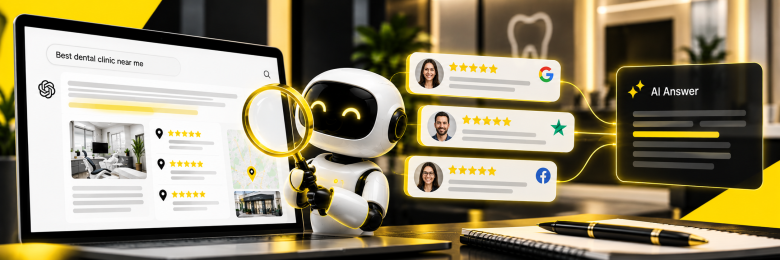
Online reviews and AI search are becoming increasingly connected. When AI assistants recommend a business, ratings, review volume and customer feedback can all contribute to how trustworthy that business appears. A well-written website matters, but it is only part of the picture. Reviews provide an outside perspective on what a business offers and how it treats its customers.
Here is how they influence AI answers, which trust signals matter and what UK businesses need to know about review laws.
Do Reviews Affect AI Search?
Yes, reviews affect AI search, although each platform weighs them differently. Reviews offer third-party evidence of customer experiences, giving AI tools another way to assess whether a business delivers on its promises.
How AI Chooses Sources to Cite
AI tools can draw on information from across the web, including review platforms, Google Business Profiles and independent websites. When several sources support the same details about a business, that consistency can strengthen its credibility. Studies also suggest that only a minority of AI Overview citations come from pages ranking in the top 10 of Google search results. This makes it worth building a reputation beyond your own website.
Why Reputation Now Shapes Visibility in AI Answers
Reputation shapes AI answers because assistants need a quick, defensible way to decide which business to name, and reviews supply it. Online reputation in AI search typically rests on several signals:
- Average rating: Consistently low ratings may make a business less appealing to potential customers and less likely to feature in recommendations.
- Recency: Recent reviews show that customers are still using the business and sharing their experiences.
- Volume: A larger number of reviews provides more feedback to assess than a handful of ratings.
- Specific wording: Reviews that mention particular services or locations can help connect a business with relevant searches.
- Consistency: Matching business details and a similar picture of customer experiences across Google and other platforms can reinforce credibility.
What Reviews Tell AI That Your Website Cannot
Reviews give AI independent proof, while your website is only a self-description. When customers repeatedly name the same service, location or outcome, assistants gain corroboration that marketing copy cannot provide.
How to Build Trust Signals for AI Through Reviews
Building trust signals for AI starts with collecting genuine customer feedback and keeping your business information accurate. These steps also support reputation management for AI visibility and Google reviews SEO in 2026.
- Claim and complete your Google Business Profile, along with relevant platforms for your sector.
- Ask customers for reviews at a consistent point after they have used your service.
- Respond to positive and negative reviews with relevant, specific replies rather than generic messages.
- Keep your business name, address, contact details and other key information consistent across platforms.
- Check new reviews regularly, ideally every week, and report suspicious activity through the relevant platform.
Staying on the Right Side of UK Review Law
Since 6 April 2025, fake reviews and concealed incentivised reviews have been banned under the Digital Markets, Competition and Consumers Act 2024. The CMA’s fake reviews guidance also warns against suppressing genuine negative reviews, and Google prohibits incentivised reviews on Business Profiles.
Strengthen Your AI Reputation with Haarty Hanks
Collecting reviews is only part of managing your online reputation. Businesses also need accurate information across their online profiles and a clear approach to building visibility in AI search.
Our AI SEO Optimisation service can help your business strengthen its online presence and the trust signals that support AI visibility. Get in touch to discuss how your business appears across search and AI platforms.
FAQs
Do online reviews affect AI search visibility?
Yes. AI assistants use ratings, review volume, recency and wording as evidence of trustworthiness, so businesses with strong, consistent reviews are more likely to be recommended than those with few or low-rated reviews.
How many reviews do I need to get recommended by AI?
There is no confirmed minimum. Visibility studies suggest recommended businesses tend to combine a rating above roughly four stars with a steady flow of recent reviews, but thresholds vary by platform and sector.
Do reviews influence Google AI Overviews?
Yes, indirectly. AI Overviews draw on local data such as Google Business Profiles and sometimes cite review platforms, so strong reviews and AI Overviews visibility tend to move together, particularly for local searches.
Can negative reviews hurt my AI visibility?
Not automatically. A mix of genuine positive and negative reviews looks more credible than a flawless record, and thoughtful public replies show an active business. The CMA advises against suppressing genuine negative reviews.
Can I offer incentives for reviews in the UK?
Incentivised reviews are not automatically illegal, but the incentive must be clearly disclosed and the review must reflect a genuine experience. Google prohibits incentives for Business Profile reviews, so avoid them there.
Are fake reviews illegal in the UK?
Yes. Since 6 April 2025, submitting or commissioning fake reviews is banned under the Digital Markets, Competition and Consumers Act 2024, and the CMA can fine businesses.